Consent
The LDM needs to make sure that each newly listed patient is appropriately informed about the goals of the STCS and that each listed patient in Switzerland receives an invitation letter to join the STCS, an informed consent form, and the pre-transplant PSQ. The Local Transplant Coordinator (LTC) has to inform the LDM within 7 days if a new patient is added to the transplant waiting list.
Definitions and types of consents
Present: We have a signed Informal Consent (IC) from the patient.
Absent (awaiting): We do not have an IC. This often occurs, when the patient did not return the signed IC before transplant and it was not possible to get the consent before opening the new case. This might also occur, if a patient is listed as ‘super urgent’ and/or was unable to sign the IC due to medical reasons. In this instance, the IC must be clarified as soon as possible!
Absent (documented refusal): The patient refused to participate in the STCS in an oral or written form, even following a personal discussion with one of our staff.
Absent (other): The participation of this patient in the STCS could not be clarified, and the patient is still alive. Please select the specific option, e.g. “Reminder process closed”, “Language/Communication barrier”.
Absent (death): the patient died while consent was “Absent (awaiting)”.
Withdrawal: when patient was registered as “new patient”, a IC for this patient was available. However, at a later point, this patient withdrew his consent by informing us that they no longer wish to participate in the STCS. The consent status should then be changed “Present” to “Withdrawal”. From this point on, only minimal data is collected from this patient.
Absent (ReCap): This is only relevant for patients who have received a transplant between 01. january 2008 and 30. April 2008. The data of these patients is entered as ‘minimal dataset’. The date of IC 01.01.2008 was entered for these patients. Check below.
Flow chart
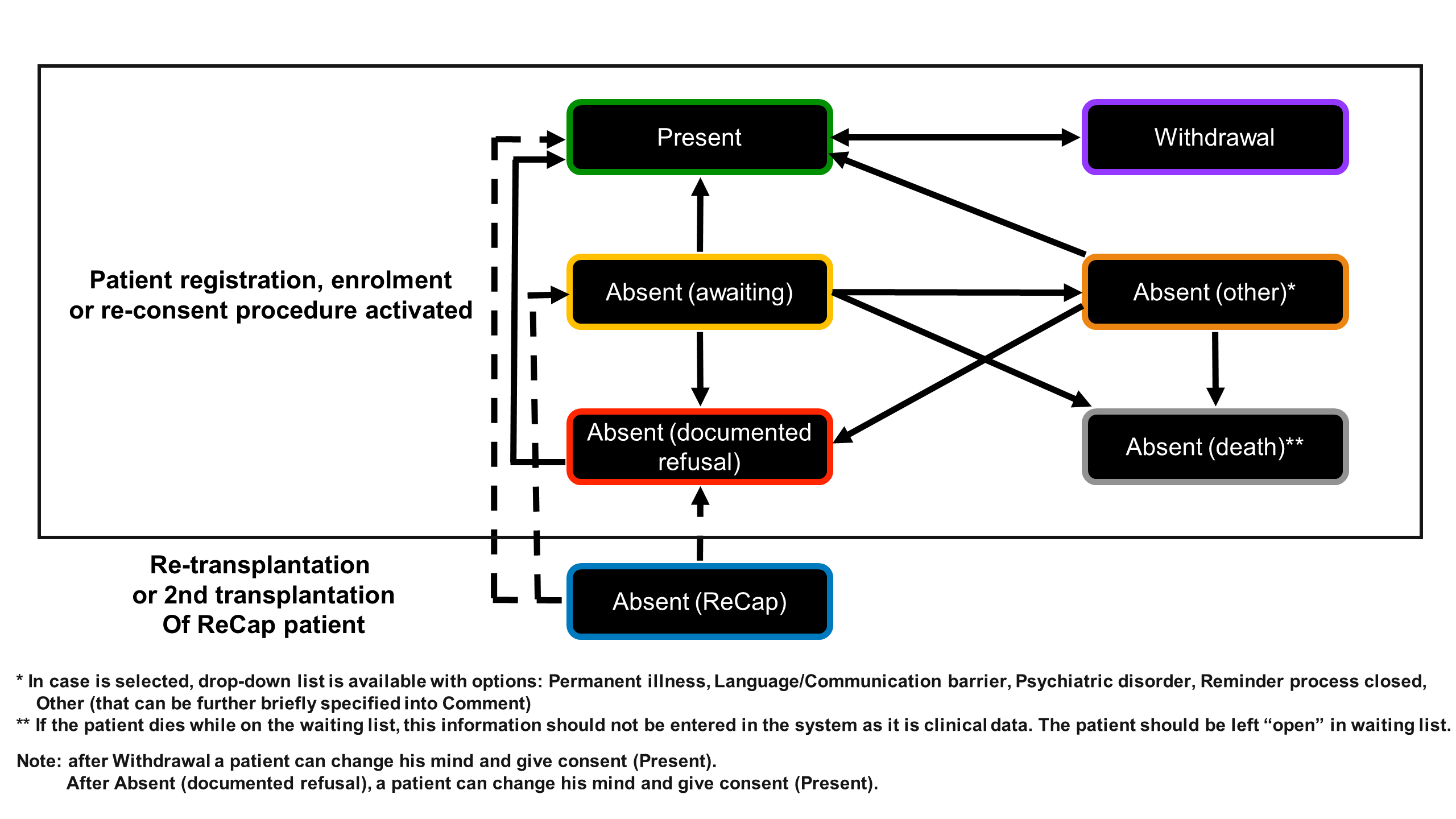
Q&A about consent
Is the patient a candidate to be re-consented?
Yes, if it is a minor (<14 years) and the parents signed/refused the first consent.
What if the consent is “Absent (awaiting)” at the time of transplantation?
Certain patients leave the requests to consent unanswered during the waitlist period. This means that when the patient is called for transplantation, there is neither consent nor refusal to STCS. In the vast majority (i.e. ~95%), the patients subsequently consent once the transplantation has taken place. To preserve human resources and to avoid delays in the data entry, the best solution for the STCS is to start collecting routine clinical data from the transplant centers (i.e. only existing non-genetic personal data from patient charts) shortly after transplantation (with reference to the time point of transplantation), even if the consent has not yet been signed.
Warning
It is important to note that neither samples are drawn nor psychosocial questionnaire (PSQ) data are collected, as long as no consent is signed.
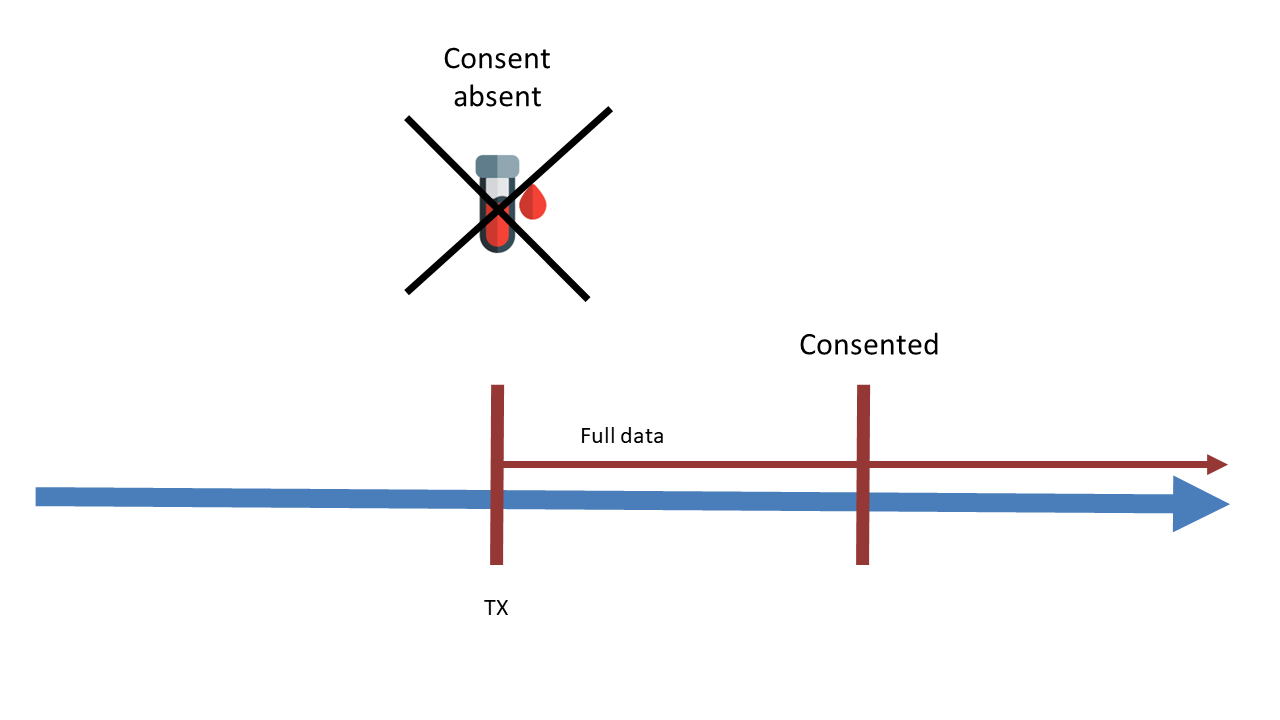
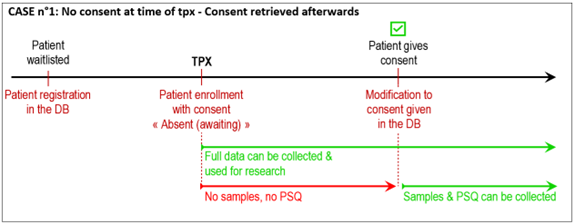
In case of consent “Absent (awaiting)” at the time of transplantation, the Ethics Committee has approved the collection of full data from the time of transplantation. Therefore, all data can be collected. This includes patient history, Baseline data, transplantation data and any data in between transplantation and the time the consent gets signed. If the patient finally gives consent, all data collected will be kept and can be used for research. Samples and PSQ can be collected as soon as the consent is retrieved (see CASE n°1).
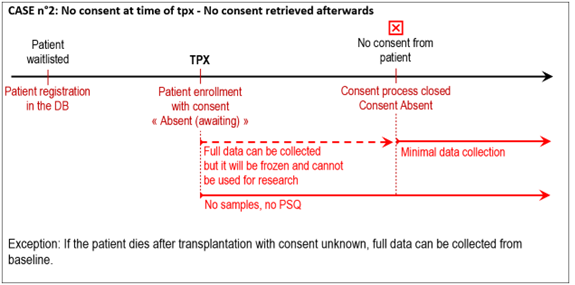
If no consent is retrieved after transplantation, data collected will be kept in the system but will not be used for research. No samples or PSQ will be collected (see CASE n°2).
How to manage attempts to obtain an Informed Consent?
Before transplantation: Three attempts before transplantation (these attempts can be done in writing or oral and must be documented in the IT system).
After transplantation, if the informed consent is still unkown, one other attempt should be done up to 6-months. If still unknown and for specific cases, one attempt between 6-months follow-up and 1-year follow-up should be tried.
How to collect data in case of “Consent present” after “Consent Absent (ReCap)”?
In case of a consent given following a retrospective capture (ReCap) please collect full data in the new forms created and the history in all the appropriate containers
Important Notes and Tips
Note
No need to re-consent in case of re-transplant, unless the patient never gave an answer, neither yes nor no. Consent does NOT depend on the organ. Consent is for STCS and STCS involves all organ TX.
Note
Oral refusal is enough, document it please in the STCS system.
Note
Consent withdrawal, please use the form with written confirmation (although legally not required).